


The Amazon ecosystem reaches a new level, and the debate focuses on scale and attracting new markets at Impacta Mais 2026.
Text: Maxi Media Communication
Image: Press release/AMAZ
At a time when discussions about bioeconomy, impact investing, and sustainable development in the Amazon are gaining depth, AMAZ Impact Accelerator participated in... Impacta Mais 2026 bringing to the center of the debate an increasingly urgent topic: the maturity of the impact investing ecosystem in the region and the necessary paths for its expansion.
Held in São Paulo, Impacta Mais is today the leading Brazilian event focused on impact investing and businesses, bringing together investors, companies, governments, foundations, universities, intermediary organizations, and entrepreneurs working to build socio-environmental solutions in the country.
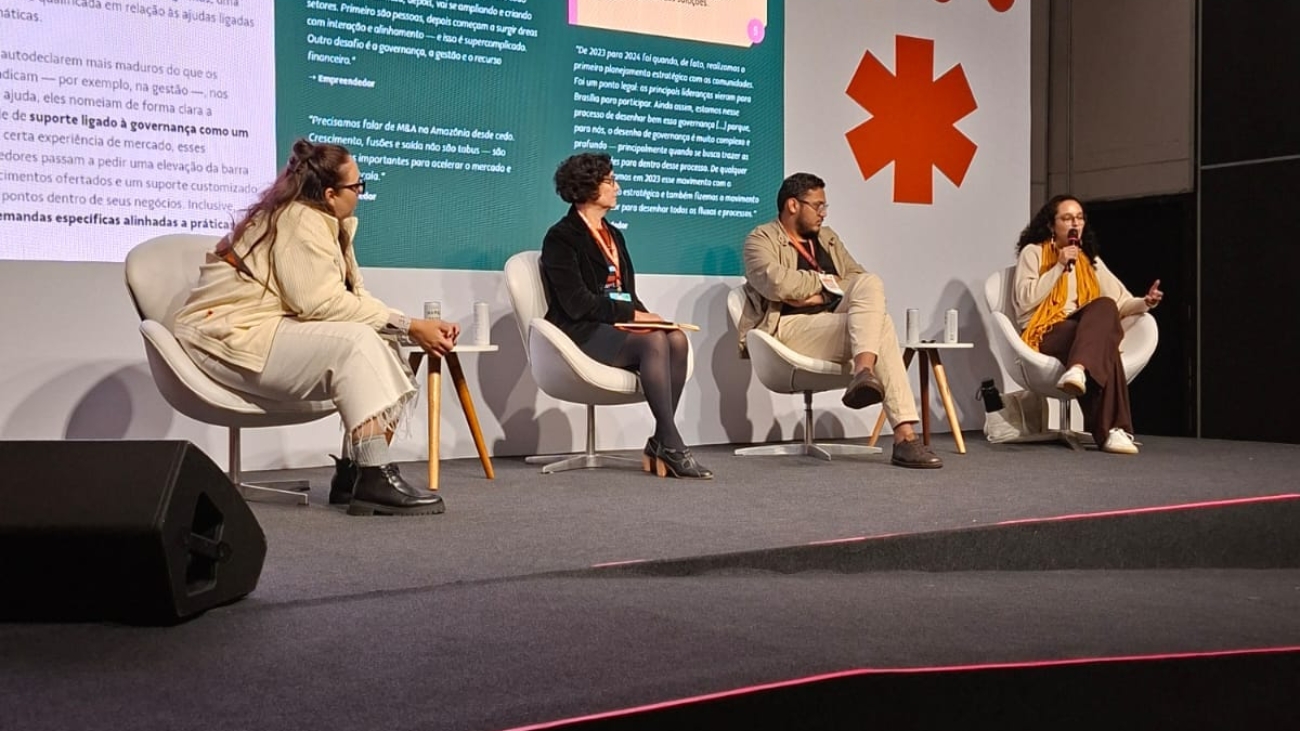
Representing AMAZ at the event were Gabriela Santos, New Business Leader at Idesam, and Macaulay Abreu, co-founder and partner of Navegam and ForestiFi, both businesses of Accelerator portfolio. The two were part of the launch panel for the study "Structuring Impact Businesses and the complexity of support: the Vale Fund experience from 2020 to 2025", conducted by the Vale Fund in partnership with Pipe Social.
In addition to presenting data, the study proposes a reflection on the lessons learned over five years of supporting impact businesses and intermediary organizations, revealing the challenges of strengthening ventures operating in complex contexts, especially in the Amazon. Among the main points discussed were the need for more adaptable support models, the importance of understanding different levels of business maturity, and the strategic role of connections between organizations, investors, and entrepreneurs.
The discussion also reinforced the need to rethink the very logics of capital circulation within the impact economy, especially in territories like the Amazon, where the challenges demand different timelines, strategies, and instruments than traditional investment models.
“When we talk about democratization, we think about the different audiences that are working on this conservation and restoration agenda. We understand democratization to include everything from the formation of associations and cooperatives at the base of the production chains that keep the forest standing, to dynamic organizations and large-scale businesses,” pointed out Márcia Soares, Amazon and Partnerships Manager at the Vale Fund, who also participated in the debate.
According to Gabriela Santos, the discussion highlights an important shift in the very stage of development of the Amazonian ecosystem.
“Before, we were discussing a lot about what the bioeconomy was, how to build this ecosystem, and what the paths for these investments would be. Now, the discussion has changed levels. We already have structured entrepreneurs, a clearer vision of how to support these businesses, and the next step is to understand how we expand this ecosystem beyond the current niche, accessing new markets and investors capable of further enhancing the impact generated,” he highlighted.
The statement points to a transformation that has been collectively built in recent years: the shift from an ecosystem still focused on validating concepts to a scenario that is beginning to demand scale, articulation, and long-term sustainability. In this context, the strengthening of intermediary organizations, accelerators, and support programs is taking on a central role in connecting capital, technical knowledge, and local entrepreneurs.
Gabriela also highlighted the importance of a systemic vision for the development of the Amazonian bioeconomy, based less on isolated disputes and more on complementarity between initiatives.
“The Vale Fund has this very systemic position, of being able to look at various initiatives and the complementarity between them. There is an important lesson to be learned about how to work together, and not just in competition for resources,” he stated.
Macaulay Abreu's participation brought to the debate the practical perspective of someone who experiences the different cycles of impact business development within the Amazonian ecosystem. With a background linked to acceleration processes and support for ventures in the region, he emphasized how structured programs can directly influence the sustainability and evolution of businesses.
“"The study highlights how support programs are part of a business's development cycle and how important it is that they are aligned with both the maturity of the ecosystem and the maturity of the entrepreneurs involved," he explained.
Amaz's presence at Impacta Mais also coincides with a time when the organization itself has been deepening processes of review, systematization of learnings, and reflection on the role of so-called intermediary organizations in the Amazon.
The experience gained in recent years shows that developing impact businesses in the region requires strategies capable of addressing multiple complexities simultaneously: territorial challenges, market access, entrepreneurial training, connecting with investors, and strengthening local production chains.

