


Text: Maxi Media
Photo: Rodrigo Duarte
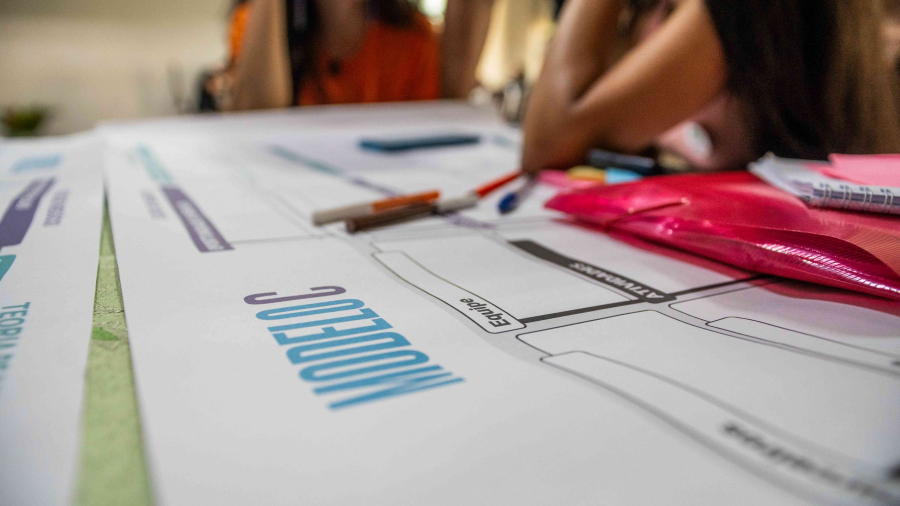
Model C, an essential tool in business modeling developed through a partnership between Move Social and Sense-Lab, has gained a “version 2.0”. AMAZ, the largest impact accelerator in the North Region, has been using the methodology since the beginning of its trajectory to support forest entrepreneurs in the construction of strategies that generate real impact. There are more than 17 accelerated businesses and 14 invested, which together help in the preservation of more than 633 thousand hectares of forest and support 750 families in 56 municipalities in the Amazon.
The new version was launched during Impacta Mais 2025, held in March with the support of AMAZ, Grupo Boticário, Fundo Vale, Instituto Sabin and ICE. The C Model contributes to the modeling and strategic management of businesses, both to understand the intentions of businesses in the ideation stage and to build a diagnostic image of those already in operation. To this end, it integrates the Theory of Change with the Business Model Canvas.
Mariano Cenamo, CEO of the accelerator and founder of the Amazon Conservation and Sustainable Development Institute (Idesam), was one of those responsible for the review. He shares a little more about how the accelerator uses the tool.
“MOVE and Sense-Lab have been extremely important partners for AMAZ since the beginning of our strategy development up until the present moment. […]. On our side, it has been very good for planning the business acceleration process, that is, we apply it in the pre-acceleration workshop, when a diagnosis and planning is carried out with the businesses that are in the final phase prior to the pitch day, where we make the investment decision, and there we can have a good overview of the business model and the construction of the impact thesis. The businesses finish the pre-acceleration workshop, the last phase of selecting those that we will accelerate, presenting the Model C,” explains Cenamo.
The versatility of the tool, which is also useful at other times in the process of accelerating and monitoring business, and extensive dialogue with the ends in the construction of more improved versions were also highlighted by the manager as a differential in Model C.
“It is a very useful tool that we want to continue using and improving. We have even suggested some points for further development of Model C, which as the business advances we feel can be used to go into fundamental details such as, for example, governance strategy and tactical-operational plan”, adds the CEO of AMAZ.
The accelerator has 21 impact businesses in its portfolio. One of them is MOMA, which develops natural cosmetics from original inputs from the Amazon rainforest, contributing to the preservation and regeneration of the ecosystem's natural resources.
Founder Vivian Chun shares that the tool has been used since the beginning of activities, also helping in planning the next steps.
“It is a tool that helped us comprehensively design the entire business in its different aspects – the market, the production chain, what we offer as a differential, how we are compensated, in relation to the impact as well, what is the soul of the business, what we want to achieve as a purpose, etc. […]. This perspective that the C Model provides is very important to revalidate what is making sense for the business, what strategies we followed or did not follow, whether the partners are firm, whether the result we expect is consistent with what happened”, explains the founder of MOMA.
Revision
The revision of the model was motivated by changes in the field of socio-environmental impact since its launch, in the language and methodological approach, adaptation for more individual uses and for more complex businesses. As explained by Antonio Ribeiro, consulting partner at Move Social.
“We started by listening to people in the impact field, seeking to gather input on the practice with Model C. With this input, we carried out a broad review of the tool, and arrived at a preliminary proposal and guidelines for testing. Then came the testing phase with stakeholders, in different territories, seeking to identify possibilities for additional adjustments. Finally, we arrived at this version 2.0, which is now public and accessible”, he details.
More than 500 impact businesses, 14 accelerators, 10 investors and catalysts, eight universities and at least ten training courses currently use Model C in Brazil.
Version 2.0 of the tool is available for download, free of charge, in Portuguese, Spanish and soon also in English: www.modeloc.co.


Add a Comment