


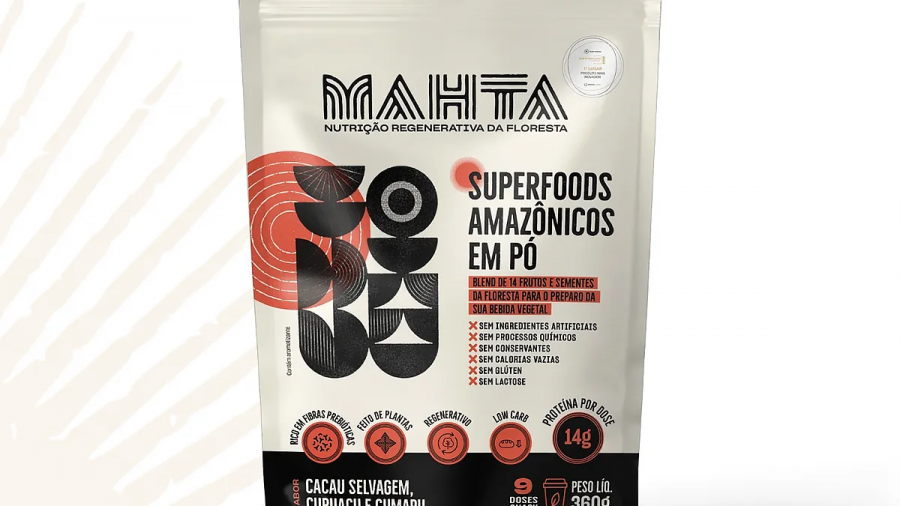
Mahta is a food tech company that produces dietary supplements with ingredients from the Amazon rainforest, delivering nutritional value to consumers and promoting conservation of the biome. Since 2021, it has been part of the portfolio of Amaz Aceleradora de Impacto, the leading company in the North Region, and was recently a finalist in the international challenge "The Great Food Redesign."
Promoted by the Ellen MacArthur Foundation, in partnership with the Sustainable Food Trust, the challenge was created in response to the report "Making Nature-Positive Food the Norm." The document recognizes the benefits of circular food design and seeks to engage the fast-moving consumer goods (FMCG) industry in building a more sustainable food system.
Through workshops and mentoring with experts, entrepreneurs created or redesigned foods focused on environmental regeneration, working from ingredient selection to the development of sustainable packaging.
One of the participants was Mahta, which uses Amazonian ingredients such as cocoa, cupuaçu, açaí, cumaru, soursop, bacuri, and taperebá to produce healthy supplements. The company develops its activities in partnership with traditional communities and small farmers operating in agroforestry systems.
"What motivated us to participate was our great admiration for the Ellen MacArthur Foundation. It's the world's largest organization working for the circular economy. When we saw the Challenge, we were very excited because it aligned perfectly with our purpose: to rethink the way we make food," explains Max Petrucci, founder and CEO of the startup.
New product development
The Amazon-backed startup received a £30,000 grant (approximately R$1,400,216,000 at the time). The funding was earmarked for the development of a protein blend containing bacuri, taperebá, and Brazil nuts, as well as other ingredients from the Amazon. Part of the funding also financed the redesign of the "Superfoods" line's packaging, now printed with renewable-source polyethylene.
Larissa Bueno, head of Research and Development (R&D) at Mahta, states that the experience of exchanging with other companies was crucial in strengthening the sustainable business ecosystem in the region.
"We understand that challenges such as logistics, quality assurance, and input supply are common to almost all businesses in the ecosystem. This further highlighted the importance of maintaining an open dialogue between these businesses and the existence of programs that encourage the circular economy when working with the biome's value chains," he says.
In addition to Mahta, ten other Brazilian companies participated in the event. In total, 57 businesses from 12 countries developed 141 new foods with potential for environmental regeneration.
Recognition
One of the most memorable moments of the challenge occurred this year on World Environment Day, celebrated on June 5th. The developed foods were displayed at Carrefour Brasil Group and Quitanda stores, two supermarket chains recognized for their commitment to sustainability.
All products also received the “Allied with Nature” seal, created to guide consumers in choosing sustainable foods.
Now, the CEO explains that Mahta's next steps include expanding its commercial operations and broadening the reach of the regenerative model.
"The Ellen MacArthur Foundation's recognition and support in expanding our distribution network through access to major retail chains is crucial. This encourages our plan to expand the impact generated by the Regenerative Forest System (SRF), which is our model," concludes Petrucci.
More about the challenge
The international challenge “The Great Food Redesign” is promoted by the Ellen MacArthur Foundation, in partnership with the Sustainable Food Trust, with support from the People's Postcode Lottery, the Gordon and Betty Moore Foundation and The Schmidt Family Foundation.


Add a Comment